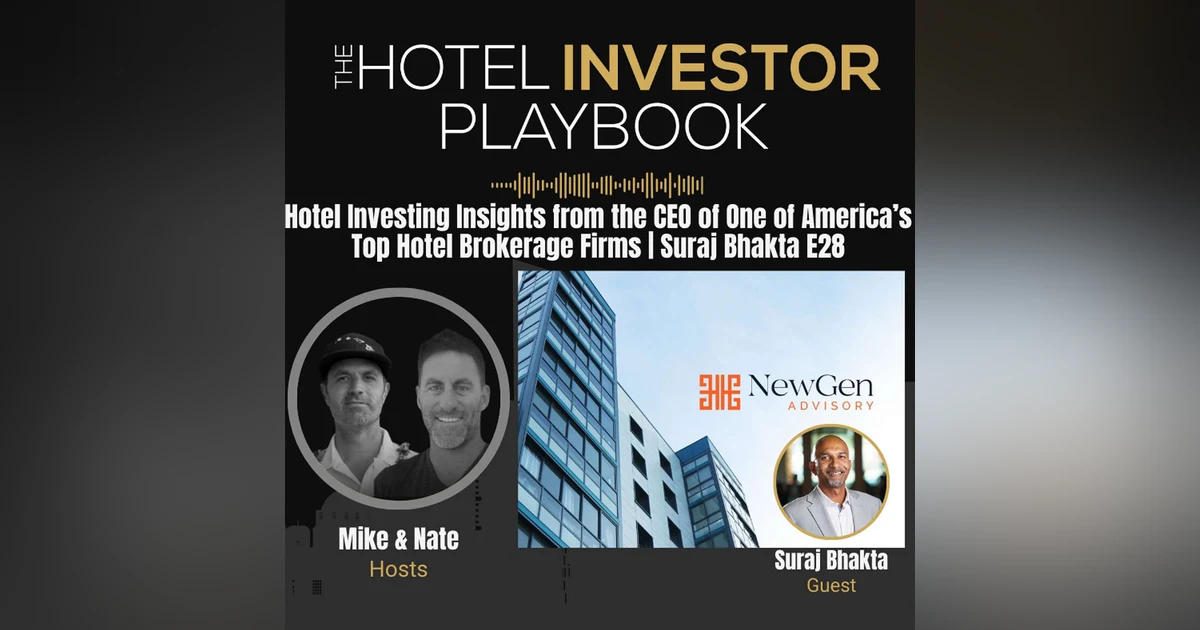
Hotel Investing Insights from the CEO of One of America’s Top Hotel Brokerage Firms | Suraj Bhakta E28


 RSS Feed
 What does it really take to scale from your first hotel acquisition to managing a hospitality portfolio worth tens or even hundreds of millions?
In this episode, Michael and Nate sit down with Suraj Bhakta, CEO of NewGen Advisory, a leading hospitality brokerage with offices across 12 states and transactions in 44. Suraj brings over two decades of commercial real estate experience, having closed $850 million in hotel deals and facilitated nearly $500 million in capital raises. He’s also Chief Legal Counsel at NewGen Worldwide and a former managing partner of his own law firm.
Together, we dive deep into the real-world playbook for growing a hotel investment business - whether you’re acquiring your first property or trying to exit a $15 million deal.
We cover:
– What makes a hotel market worth investing in
– How to raise capital beyond friends and family
– Why the real pros plan their exit before they even buy
– SBA loans vs CMBS vs local banks: financing pros and cons
– The risks and rewards of boutique hotels vs flagged properties
– Why extended-stay hotels are gaining momentum
– How top investors scale and what separates them from the rest
If you’re serious about building wealth through boutique hotels and experiential hospitality, this episode will help you play the game like a pro.
Connect with Suraj:
Email: suraj.bhakta@newgenadv.com
Website: https://newgenadv.com/
Linkedin: Suraj Bhakta
Instagram: @newgenadvisory
Connect with Mike and Nate:
Instagram: @the_hotel_investor_playbook
Contact Us: info@hotelinvestorplaybook.com
Invest with us: Visit Malama-Capital.com for more information.
So here's the real question. If you put millions into a hotel deal, who's actually going to buy it from you down the line? Because closing the deal is just the beginning. The real pros play the game with the exit in mind. In this episode, we're talking with Siraj Bakdat, CEO of New Gen Advisory, who's closed hundreds of millions of dollars in hotel transactions over the last 20 years. He shares real-world insight on how to navigate acquisitions, raise capital beyond your inner circle, and position yourself for long-term growth in the hospitality game. If you're serious about scaling into boutique hotels and you're ready, or you're already in the game and thinking about that next leap, this one's a must. Let's dive in. Welcome to the Hotel Investor Playbook, your guide to building wealth and freedom through boutique hotel ownership, hosted by Mike and Nate. Get in the game, welcome to the Hotel Investor Playbook. We're Mike and Nate, founders of Malama Capital, and your hosts. On this podcast, we talk story with industry experts and professionals about everything you need to know to make money investing in hotels and hospitality assets. So on today's episode, we've got a really special guest, Serge Bakda. He's the CEO of New Gen Advisory, a powerhouse hospitality brokerage company. He helps investors buy and sell hotels all across the country. He's also the chief legal counsel for New Gen Worldwide, which is the parent company. And Serge has been in commercial real estate for 20 years and he's closed hundreds of millions of dollars in deals. He really knows what it takes to navigate hotel acquisitions and financing and all the moving parts in between. So whether you're trying to buy your first hotel or scale up to something bigger, this is the guy you want to hear from.
Suraj BhaktaThank you, Michael.
Michael RussellYeah, we're happy to have you here. I want to start off with a question here. For our listeners, many of whom are short-term rental investors or aspiring hotel owners, what does it really take to buy your first hotel in today's market? And how do you avoid the most common pitfalls that most first-time investors fall into?
Suraj BhaktaThe hospitality world, I feel like, has evolved in a lot of different ways. And I'll give you a little bit of a personal story because I grew up in the hotel hotel industry. And for me, my parents came in, they bought their first small independent motel back in the 70s. And this was like an 18-room motel that was in a small town in Indiana. And I've seen this evolution of people wanting to get into hospitality ever since that. They'll get into these smaller properties. And now in today's world, the Airbnbs and the short-term rentals, that's kind of the same kickstart, I guess, if you're looking for that a lot of people are kind of going along the path. And my parents were fortunate. They went from that small independent motel to having two or three of those at one point and then getting their first franchise. And that kind of was like the next big step for them. We went from having one or two franchises, which were typically economical brands, more like Super 8's and Days Inns and Econo Lodges. And then that they would step up the ladder of branding at that point. And in today's world, there's a lot more to navigate. I mean, it's it's it's a challenge, right? I mean, we've seen some of the costs and the things rise in a different way. And debt obviously is a big portion of how you have to deal with these things. But there's also other challenges. I think with inflation coming up, the people are looking at where these rates are going for a lot of things. So those are always new concerns. And when do you really turn the corner? I used to tell people the last two decades, a better part of the last two decades, all the business guys I've known, and I'm an attorney by trade, so I've seen a lot of small and mid-sized business guys. And I always said there's like that businessman ADD. They they really played the game of wanting to get through acquiring an asset, running it maybe two to three years, sometimes a little bit longer for, but they would really turn and make the play on the equity side quite a bit. I think in today's world, you're looking at a little bit of a longer hole, just mainly because some of these debt costs and your point of entry, that acquisition cost today is a lot higher than it has been historically. And that's the challenge in today's marketplace, I think. But a great place. I mean, hospitality, I've been in it all my life, working from an attorney's perspective. I've also worked for my parents as a kid. And when I say I've done every job at a hotel, you'd imagine from cleaning rooms and cleaning the bathrooms to sweeping the parking lot. I I kind of get the in and outs from the operation side there.
Michael RussellRight. So I take a look at your website and you've got a lot of resources there. You've got a big company. I thought you've got 13 different 12 or 13 different offices in like 40 something different states. I mean, you've got dozens of associates and team members and people out there that are that are helping people to buy hotels. And when we're looking at, well, where should we be investing in a hotel? There's so much data and information. How do you filter out all of the noise and really focus on, okay, well, what's going to be the right fit for me to start? And so, more specifically, like, what are some of the go-to data points that you would suggest looking at when evaluating whether a market is strong for hotel investment? So, how can novice investors access this kind of data as well?
Suraj BhaktaSure. Yeah, look, a lot of the data is available. Now, CoStar is one of our great sources of data and information. They're the ones that actually have apartments.com and how homes.com and a lot of these dot com companies where people go and find rentals, but they also are one of the companies that own, it's called Smith and Travel Research. It's called the Star Report. They've got the data on the entire market. If I said, hey, I want to go look at Phoenix as a good example, right? I can go into CoStar and it'll pull up what the generic ADR, which is our average daily rate, occupancy, and then RevPAR. Those are the three metrics that tell us all the story when we're talking about transactions. Those are the first three things we'll look at is how's that property really performing and how is it doing based on its competitive set? So other properties that are similarly situated in that area. And they and it breaks it into different tiers as well. So you'll have an economy of mid-scale, upper upscale, upper upscale, all the way up to luxury. And so that's a great place to start if you really want to know is there an opportunity here, right? And it depends. It depends on what's important to the investor themselves, right? I recently had a conversation, guys like, hey, get me in a market. If that property has over a hundred dollar ref par, I'm in. And then we're like, okay, well, let me go find a property that's doing that. Others will say, I'm I'm more concerned with longevity. I want a location that has that high barrier of entry. And you can imagine universities, downtown locations or uh destinations like Scottsdale and some other places. It can be really, really unique thing to have a place in in some of those locations because they're hard to get. And then some guys will just say, hey, look, I need the deal. And I usually say everybody else wants the deal too. But what do you mean by deal? And it's really what's the thing that I can do that if I come in, I'm going to do better than the guy that was currently doing it, right? Is he feeing this thing because he's doing it with third-party management or something different? Or are they just poor operators from the standpoint that I can create efficiencies right off the bat? Every operator from a hotel standpoint has their own strengths and weaknesses. The bigger you get, you start looking at your investments a different way. But if you're the first-time buyer, I think you want to be able to look at what are the occupancies and what that rev part really changes. And I can tell you, like, hey, am I really going to come out of the other side on this in a reasonable time frame? Because a lot of guys will take a chance on a property, maybe not make too much money for one or two years, but by that third year, we're really looking to turn that corner. And I think that's how you kind of analyze most of those scenarios. Yeah.
Michael RussellSo my mind is spinning a little bit. I want to zoom out and I want to zoom in. Okay. To start, you led with, hey, right now, this market climate, you got to kind of expect more of a longer-term investment. And I'm curious in comparison because your firm focuses on hospitality, hotels specifically. And most people, when they're thinking about raising money and how they're going to position this for investors, when you start to say, hey, you need more runway, you need more time, then it seems like, whoa, that's going to be an that's going to be a little bit of a hazard because there's a lot of alternative investments out there, whether it's multifamily or warehousing, industrial, that sort of thing. And with hotels, look, you just you got to bank on a longer term. Number one, in your mind, what is really the forecast? Like if someone were raising money, what should they communicate to their investors that should they should bank on? And then also, what sets hospitality apart from these other investments to make it more advantageous from an investor's perspective?
Suraj BhaktaSo a couple ways to look at this. I mean, if you're getting into a new construction or new development, that would be really different than that if I buy something that's turnkey today, right? Because if I have a fund and my investors are expecting something in the next few months to say, hey, we need to start seeing where this return is going to come in. Well, I'm looking for a turnkey operation. In fact, I'm probably looking for the properties that's going to have that high RevPAR. We're looking at NOI, we're looking at the EBITDA, because that's at the end of the day, that's where we're going to see if it's really going to make a difference for our investors. Now, the long-term play, look, if you're getting in the development side or the project needs a lot more TLC, right? And in the hospitality space, we we refer to a lot of things by what we call PIPS, which are the property improvement plans, right? And those property improvement plans sometimes can be small in the sense I might say a couple hundred thousand dollars all the way up to two, three, four million dollar improvements, right? Depends on what the brand mandates at the time if you're going to go switching over, assuming it's branded. Now, if you're trying to put money into a deal and make it a really nice boutique that might be independent, but it still needs its own touch and characteristic, well, that costs money too and takes time, right? That downtime you can't afford. So I think it's it's really when you look at the investment, it it's the runway is going to be based on the amount of work that you have on the front end or not, right? I can sell a deal to a buyer saying, hey, look, this property is performing top-notch. It's top three and it's comp set. It's in a great location. There's no work that needs to be done. You jump in at the price you do, you'll probably turn the profit right away. If you have a fund and you need to make sure your investors are taken care of, that's the way you're going to do it. Now, others, they may be smaller groups. Like we get a lot of guys that are small families, and they'll get friends and family rates to come in and say, hey, I got investors that are just mostly friends and families. So maybe a group of five people, they probably are pallading to say, hey, we want a long-term hold. We want this investment to be more of an equity play for us as it grows and continues to become an asset that can cash flow for us.
Nathan St CyrIt really depends on your investor board. Okay. So I want to get a little bit more specific and provide you with this scenario and then get your opinion. So we're seeing a pretty significant wave of short-term rental experience, people that have experience or that want to scale and they're going to step up and they're going to they're going to purchase their first property. And in this scenario, a lot of them look at these call it 10 to 30 keys, and they want to go and put capital into it and take something tired and make it nicer. And then the second thing that they want to do is they want to go and they want to go staff like and they want to utilize technology and they want to take a lot of the STR play and put it into play into that hotel to take advantage of the opportunity of scale. And then they're they're syndicating it, right? So they're going to say, hey, we're looking at a seven-year hold, we're looking at 18 to 20% IRRs and 10% cash on cash. So they they create this very common scenario. But in my mind, what I'm wondering, and someone with your experience, is I'm thinking about the exit. So they go and take basically take everything that's there, all the meats off the bone, right? They go and they go staff light and they go capital improvement. Now it's seven years later. I'm wondering, who do you see is gonna buy that? If this is a $7 million property, they put $3 million into it, and they think that it's gonna be a $15 million property at exit. Who's the investor that's purchasing that?
Suraj BhaktaThat's a great question. I see that at like varying different scales. And so what I've seen recently as people grow up the scale, a lot of the institutional guys buy at smaller caps than we believe. They do it based on volume and scale. And so what they're looking for is gonna be very different than that which a kind of a main street player would do, right? So so let me differentiate between the Wall Street guys and the main street guys. Yeah, Wall Street guys are like, hey, we're putting this thing in, it's gonna be there. We're not we're they're not in the business of selling usually, right? So if if you're buying something, you do that and you got it ramped up and you got it to a place down that road and you said, hey, this thing is now 15 or 30 million, and you find that buyer from Wall Street, they'll typically pick it up because if it has the right metrics to it, it can fit right into their portfolio and then it's it's one added piece, right? It's an asset play, they know where it's at, they may be more keen on location. They're very picky about what they want. But if you're doing as well as you are in that seven-year time frame, they'd be the ones that would be the best candidate for that, right? Others on Main Street, sometimes they're looking, but they're usually looking for the deal, like you said, the value add guys, right? They're not going to be the ones that are gonna come in and say, I'm gonna buy that at top level. They're looking for returns that are slightly different from their own. But that allows them to grow up that chain and ladder as well. Because most guys, as they get through that, they become these bigger, large, bigger and larger portfolios. I it used to be back in the day, somebody had four or five properties, you'd be somewhere in that five, ten million dollar range. These days you can be in a hotel asset in any city and be anywhere from five to ten million per asset, right? And that can really catapult you. You have five properties, you could be $50 million in asset value. So, you know, it changes as you go up. But yeah, to your question, the best candidate for that is somebody that's coming off of Wall Street. They'll come in and suit that up.
Nathan St CyrOkay, understood. And so along the same lines, taking it from the perspective of getting started, Main Street, syndicate your first deal, utilize most of your sources of your network, right? You're to to to gain that that first bit of capital on that first deal. But now that's not your goal. Now you're on to property number two, right? I saw in your the you've raised $500 million of capital throughout the years or some absurd amount of money. So what I'm wondering is once we get into that, we're actually scaling past our network. Who is the the really the target investor that wants to come along for this ride?
Suraj BhaktaGood question. Look, it can vary. I think it depends on where you're at and who you are. Because the trust starts with the operator, right? The guy that's actually putting the package together and whatnot. Also depends on how big of a package you're putting together, right? Are you trying to acquire something? You're is your next property something that's between the one to five million dollar range? Or are we moving into something that's the $15 to $20 million range, right? Those investors will inevitably change and evolve. From a legal perspective, a lot of times you run into some boundaries, right? Like LLCs can only have so many members and all this other stuff. If you get over a hundred investors, you have to start thinking about securities laws and stuff like that. So I think it varies on what the dollar amount really is for that next property. But I think it grows from people seeing success. So to me, if you're asking me, it's usually friends, family, and peers, right? It's people that know you, live amongst you, and understand your success, right? Those are good, those are the best investors that are coming along for the ride. But they also don't want to get into operations, right? They don't want to go have to do the renovation. So it's that investor that says, hey, I see you're getting returns. I don't need your return, but I need a better return than what I'm making in my current spot, right? And and they may be doing something in the i single digits or something like that. Maybe that's okay with them. You might be able to tell them be like, look, I can get you 10 or 12. And then there's a spread that goes on the back end. If you're making 19 points on a deal, that there's a lot to work with when it comes to hospitality. And I think those are some of the difference makers when you talk about hotels and hospitality assets. Um, your margins can be significantly higher if done right than most typical investments. I love that.
Michael RussellYeah, I think you there's a lot to unpack there, right? So you're talking about different types of investors. You've got some that are looking for just yield, right? They want to place their money. If they're Wall Street, they have big sums of money and they have to place it. And so they're looking for bigger investments. And then if you're looking at someone who's just getting started, who's raising money from friends and family, you're kind of just getting little bits and pieces and it's it's a totally different avatar. But to Nathan's point, yeah, there's this big question mark like, okay, we go and we find a value add opportunity, and it's like, look, we can get this thing to pencil, and it's gonna be worth this much because when we go and increase the NOI based on the cap rate, it's gonna be worth 10 million instead of 2 million or whatever, right? But the point being, well, who's the buyer for that 10 million? Because it's not quite big enough to get the attention of the Wall Street firms, and it's too big for the small mama poppers that are looking to do the value add. So there's this no man's land that I guess we're like, we're wondering, okay, well, what's the vision? What's the plan? And when I'm looking at your website and I see all these different properties, these listings, this is where I want to dig into your experience and be like, okay, well, what are these people doing that have done the value add transition? Who are they exiting to if it's not Wall Street and it's not the mom and pop? Who are these people that are looking at already stabilized assets that are providing a yield that are not Wall Street?
Suraj BhaktaLook, and that's a great point. I think when you look at it, whether it's the ladder or the pyramid, there is always someone below you and always someone above you. And those opportunities sometimes can go both ways, but a lot of times it's everyone working their way up the ladder or up the pyramid, right? And and so when you start looking at these types of investments, and I'll give my shameless plug a little bit here, but brokers are great resources for that, right? I mean, we as agents, I always say our ears to the ground, I know who has an appetite today and says, hey, I'm looking for something. Hey, I have a 1031 exchange, right? And that those guys are the best buyers. I mean, they're they're ready to jump because they don't want the tax implications that happen if they have to take all the cap gains in. So they're really trying to move quick and fast. And so finding the right asset, they'll pay for it, right? They'll want to get into something because they're not looking to lose money. They want to be able to say, I cashed out on this deal and I got 15 million. I want to buy three deals, and my equity in for all three of those is going to be five million each in just a very basic world. Five million, you could be purchasing three assets at 15 million each, right? I mean, that's a a very reasonable down payment and loan to debt. Ratio there for you. So I think those you'll find that no matter where you're at, brokers can be advisors in a lot of ways, right? We know what's happening. If it's not that, we may say, hey, look, there may be a hold period here. Put two or three of these together, and then we can go get that guy that's not just above you, but two steps above you. He'll take three rather than one. There's opportunities in scale for those guys. And so you can get a good opportunity in that in that respect.
Nathan St CyrLook, no, and that does make sense that the dynamic changes. Like if I just think about myself personally, and we go and attack something with a value add, it hits its value. We force that a significant chunk of equity on exit. Now what? I don't necessarily need that equity to go into another value add. I might just want that equity now to go into a more stabilized asset where now I'm reaping the benefit of all of the equity that I just gained, but more from a cash flow standpoint. So I can see how that dynamic can change. And there's just different seasons of someone's investment needs. So that's that's a great point to be connected to the brokers that really have an understanding of what's happening in the market.
Michael RussellYeah. I want to dive into something I read online. You were interviewed for an article and you described how you've been in this game for a long time and you've witnessed firsthand some of the people in your community or some of your peers who have started relatively small and now I think have grown to from independent properties to billion-dollar portfolios. What are some of the common traits or strategies that you've observed from those that who've who've eventually made it big?
Suraj BhaktaMost of this starts back probably 60s, 70s, where people started picking up a lot of assets and it's grown since then. But when I look at it, you got to be a risk taker, right? It's the common phrase of higher the risk, higher the return scenario. You also have to kind of be able to be resourceful. I mean, I've gone through myself a good number of ups and downs in the economy since 9-11, the financial crisis 06-07 timeframe to COVID. There's been so many different things that bring different challenges. And it's resiliency, I think, somewhere in along the way. Like you have to get creative. And it's not just creating operational efficiencies, right? It's really understanding all elements of the deal, whether it's finance, whether it's the franchising model, you have to understand these little components that can really make the difference. And I'll tell you like one of the things growing up that we used to always talk about was we were all in the hotel industry. So people would say, hey, look, don't get caught being the front desk guy. If you're the owner, you shouldn't be running the front desk. Just because you think you're saving a few bucks and cutting some salaries out, and I'm like, you're spending your time there, that's not the place for you. Right. If you're the true entrepreneur, you got to get out there. And you're looking at how to increase sales. Sales is something where back 70s, 80s, and 90s, we still relied a lot on transient traffic, people walking in through the front door and you being hospitable to the guy that just walked in, whether it's a a traveler with his family or a truck driver going cross country, right? Um, now everyone's shopping online, right? So it's really understanding how technology is coming into our space and how things work, because we obviously have Expedia, Travelocity, all these other sites that want to do what they do, the the travel, the online travel agents, the OTAs go a certain direction, but there's a lot you can do individually, and that that adds to that bottom line really fast. So I think that's one of those things that people look at is how resourceful can you be in adapting to the technology and getting better at those types of things.
Michael RussellHey guys, at Malama Capital, we're always on the hunt for the next great hotel deal. And as you know, the best opportunities don't stick around for long. If you've got capital to deploy and want to invest alongside us, hit the link in the show notes and drop your email. You'll be the first to hear about new deals we're working on. Now, back to the show. Okay, so somewhat related to that. I'm curious to know what's your take on boutique hotels versus flagged properties when it comes to risk and upside for newer investors.
Suraj BhaktaI think in today's world, boutiques, they're obviously very popular in a lot of different ways. Not everyone is great at executing on the boutique value. They may have the vision, but they don't know how to sell it. Some have the selling ability, but they don't have the vision to put it together. So it can be one or the other. But there's to me, I love the boutique style. I think it's phenomenal because it's true um entrepreneurship in its best fashion and it's hospitality with everyone's own personal touch, right? You create this characteristic of your property and this theme or whatever you style you want, whether it's that chic casual lounge that you create in your lobby space or the rooms have a retro vibe to them or what that might be. I think that speaks volumes for people and investors individually, because they they can create that ambiance and space of what we envision in today's world. And a lot of people flock to that, right? I mean, you have a better margin side on a lot of those boutiques and those locations. And look, boutique can be misused in a lot of ways. The the the the coined phrase of boutique. I mean, once the boutique started rolling out, the brands actually tried to follow suit too in their own way, right? They have these soft brands they talk about, and the soft brand is supposed to entail maybe the location that it's in and some elemental things or whatever it may be. But look, I I think all in all, brands always have their place. There's loyalty to it. It is a Monday to Friday business traffic type of place. But in today's world, we all know bleasure is a big thing. And when I say bleasure, it's the business leisure guy that is kind of, I can work from anywhere space, I can work with my family, travel with my family. Those are the boutique guys, and I think boutique goes a long way for those guys, and they're willing to spend a little extra to get that feel, that comfort that they want if they're going to be there a little bit longer.
unknownYeah.
Michael RussellWell, I know that you've got some experience in extended stay hotels, right? Maybe you can explain why you think that there's opportunity for investors in in that specific type of hospitality class.
Suraj BhaktaYeah, look, extended stay has been all the rage since pretty much coming out of COVID. Let's define it a little bit, right? An extended stay is really when you get to the property, these are people that are not staying just overnight, right? They're usually there for a week, two weeks, sometimes months at a time, but they're usually paying on a weekly or a semi-monthly type of payment. And so they're there for a little bit longer time. I think the benefits that people look at in extended stay today is there's a lot of efficiencies, right? You're operating the same size building. So it may be a hundred-room hotel or a hundred-room extended stay. But the hundred-room hotel, because you're renting stuff daily, you have more housekeepers, you have more things that you're doing on a daily basis, you're providing breakfast, you're doing all these other things. Now you may still do some of those things with the extended stay side, but you don't have to do all of them, right? Because some people are like, hey, I'm here for a long period. I don't want somebody in my room every day. I'm not going to have it cleaned every day. There actually, a lot of them have rule policies. If you're here for a week, we clean your rooms on these for following odd days or whatever it may be. But there's some efficiencies of scale, right? You're able to do it with a slimmer operation from a from a labor standpoint. So you're able to save some costs on that end. And it costs exactly the same. So when you start scaling those expenses back, that margin increases very rapidly. The the guys that are in the hotel space, they don't typically like to rent long term because it wears down the rooms very fast. There's a lot of wear and tear on it. Whereas on on this side, if you're in the extended stay, these guys, they can do what they the daily rate too, right? And they'll rent it out for the day or for the month week or the month. And so the the benefit is is pretty good there. And then I think a lot of guys have really said, hey, it's the best of both worlds. Why don't we do more of this model? And so it's been very popular late.
Nathan St CyrYeah. If that's okay, I want to switch gears about some of your consultation and what you really specialize in and help with is the funding side, not just a capital raise, but as as much so the financing side. And so I've got two questions. The first one is we see a lot of people going in where they might start with some shorter term private private debt. And then it comes time to to refi. And I I really want to ask your opinion on what you feel like or where we're at and where we're headed with when when we have post-stabilized properties, what the expectations are as far as gaining what you feel the best source of permanent debt that somebody can expect. So that would be the first question.
Suraj BhaktaGood question. Look, lending is a a fluid space these days, is what I say. It depends on the location and the place. I actually think the local banks are still kind of the best source for a lot of these things, right? When you have a local lender that understands your space in your market, they're willing to take the time to really say, hey, here's the here's the pieces you need to make sure we can do this refin. The other guys that maybe a larger outfit coming out from somewhere else, but they're focusing maybe on a particular asset class at the current time. And if this quarter there's like, hey, we want to do some good hospitality assets and we have the appetite for this, this, and this, they may be okay, but you know, they may not be in it for the long game, right? They're in and they're gonna move your loan at some point, whatnot. But the local guys, they still have the best appetite for you, right? So if you've gotten destabilization, then they know it, right? And the local guys can assess, give it all the things that are on the fringe and surrounding the property, right? So we look at demand generators and we look at other things. I think those things are easy, a little easier, easier for local lenders to understand and adapt to. But now if you have a troubled asset and you're trying to refi, that's a different story, right? Like stabilized is is good, but a lot of guys, they're just in the deal, they got into it quick, but now they need to re-fi. That's that's a challenge. Your local guy's not gonna jump up to that play, right? Then you're trying to find that guy that may just be like looking to put a bunch of loans together and maybe sell the package of loans at some point. So you want to see if you can qualify for one of their deals with one of their lenders or whatnot. That's kind of the best case scenario there. But yeah, if you're stabilized, local guys are your best bet.
Nathan St CyrWell, let's get a little bit more specific on right now. I'm sure I've got a stabilized asset. We've we've we have a good, we've been doing it over the past 36 months. We're we've got good numbers, we're going to our local bank, and we want to secure the most competitive opportunity for us and our margins. And and let's say there's appetite for this. What could somebody expect out of strong terms? Strong terms. You're talking about for your rate and and the kind of length of time, rate, what a what a perm what a permanent debt would look like.
Suraj BhaktaI think a lot of lenders, again, when we talk about DCR, the debt coverage ratio, that's where we'll usually look at it, like 1.4 for hotel hospitality, right? To what I say hotel hospitality, very specific. If you're getting into the um, you know, kind of the short-term rental Airbnb space, it might be a little bit different. But for hotel assets, typically we're looking at a DCR of about 1.4. That makes most lenders very comfortable. I have seen guys that look into CMBS, which are the commercial backed securities, right? So our mortgage securities. So that's a great place, I think, when you are at a stabilization and you're doing well, then that's a good place to refi because they will give you uh good value. But they have very particular ratios, not just for debt coverage ratio, but you got to have reserve accounts, you have to have the X, Y, and Z pieces that all kind of fall into play. So sometimes their requirements can be kind of stringent, but if you have the right type of assets, that's not a bad way, the bad way to go. You can really get that, those numbers to jive for you.
Michael RussellYeah, the only thing about that, though, I've heard they can be extremely ruthless, right? You work with your local bank and they represent the community to a degree, and so they're gonna try to work with you to if something goes wrong. That that the local banks will typically be somewhat more understanding. And we've had experience with that COVID. We called the directors of the bank and had a conversation and we're able to negotiate something that worked out, and we were able to get through that period without losing the asset during a very tumultuous time. But with the CMBS, it's just like cut and dry. You don't have the money, sorry, you're out.
Suraj BhaktaYou're 100% on the point, Michael. I my experience is no different. But there was a moment in time, look, a lot of folks appreciate CMBS. If you are at a position where your property is a very solid performer, then you can because you could get a lot of they used to have a cash out refi, right? So you're able to take a lot more money out than you really need, but you're able to grow to your next asset, right? So those were good opportunistic things from a owner standpoint or investor standpoint to say, hey, let's roll that money over. It's doing enough that we can put this loan into place. But like you said, the minute you hit that hiccup and those ratios fall below a certain categorical level, it's a technical default. And those are the worst, right? Those are like, are you serious? I'm making my payments, but there's no one to listen to you, like you said, Michael, right? Whereas your local guys, you do, you have a good conversation and you can say, hey, let's defer this, let's do whatever we need to to make sure this succeeds for both both of us, right? We'll we'll make up the payments as we go, that kind of thing.
Nathan St CyrAwesome. Okay, and then the other question that I had, this is this is one that we get multiple opinions on. So I'd like to get yours. What has your current experience been with with SBA on someone's initial purchase?
Suraj BhaktaI love SBA. And you're gonna hear this because I've always said from my background as an attorney that represents a lot of the small and mid-sized businesses, SBA is it's it's part of this entrepreneurial process, I think, for a lot of folks in the in the United States. And it's very opportunistic that we have such a program, right? Other places don't offer this type of thing. And so if you have the opportunity to buy a business and you can use your SBA, I think it's great. I think they offer still very competitive rates. Although, I mean, in recent times it's been a little bit tougher, just given that rates in general have increased. So we've seen it kind of go up. But it's it's a very good starter place, right? If you're buying your first property, use your SBA. It's the fastest, the best route. You can probably qualify pretty quickly, and you can find a participating banks. Local banks love to participate with the SBA guys and it makes life easy for them as well, right? So I think it's it's good. I and I actually say for people starting out, use that opportunity.
Nathan St CyrOkay. And for I know that you've got pages and pages of listings. How do you how do typically your sellers, if somebody comes in with an offer and the offer has SBA financing attached to it, how do sellers uh look at that?
Suraj BhaktaThey don't mind it. I usually have my agents temper expectations, right? It takes a little bit of time sometimes with the SBA just because you got to jump through a handful of hoops, but the hoops aren't that bad. And if you have a good agent, they'll kind of walk you through it, or if you have a good mortgage broker that will be able to walk you through it as well, right? So there's a good opportunity, I think, for people to work through it. It is not as complex of a process as people believe it to be. Pretty easy to qualify for, I think, in a lot of respects, as long as you deal pencils the right way. So I think it's it's fine. As long as you give me a timeline and we stay relatively close to the timeline, they're in good shape. Got it.
Michael RussellYeah, I want to ask you a little bit about your brokerage services. So you mentioned that you had a client that said, Hey, I'm looking for a specific uh Rev bar. And you guys were like, All right, we'll go find the market, the region for that, and we'll we'll deliver you an opportunity. And so my ears perked up a little bit. I'm like, oh, oh, interesting. Because we're out there trying to pound the pavement and contact brokers and find deals and uncover stuff. And we do have a niche product or actually engaging in searching for purchasing a hotel, but we have experience at hostels. We're excellent hostel operators, and we've just carved out this little niche and we just know what we're doing and we know how to operate it. And so there's not a lot of competition in this sphere. So we're out there trying to figure out well, where can we buy our next hostel property? And we're doing so independently. Yeah, we call brokers, we have conversations, but we don't really have someone that's like an industry professional that's just like out there working for us. And I guess I'm curious with your brokerage firm, would you take on a client like ourselves where we'd be like, hey, let's can you go find us our next hostel property? These are the you know, this is our buy box, these are our conditions. Do you do that for clients? Is that how it works? Or how can you yeah, yeah, absolutely.
Suraj BhaktaNo, good question, Michael. And absolutely. We can that's the type of stuff we love. I'll give you an example and kind of an analogy for for this situation. I mean, we've done a lot of work in conversions and adaptive reuse for hotel properties. There's a there's a big belief that a lot of people think the bones of a of a hotel development has all the right components for a lot of different uses out there. And so, like even before COVID, we started doing some stuff where we were selling hotels to student housing. We were selling hotels to assisted living or senior care. Even post-COVID, we started selling hotels to convert into veteran housing, transitional homes, multifamily. And so we started touching base with a lot of folks that wanted to do these types of conversions of hotels. And they would take a hotel property, switch it over, and say, hey, this is my criteria. I need the rooms to have this much space, or I need X number of doors. Because when they take a hotel, say there's three rooms, they'll consolidate into two rooms where they create them as L-shape, and that becomes like a mini suite. But they lose doors, right? So there's there's a little bit of an economic impact on how they have to do their number crunching. But all in all, because the bones of the hotel are so good, they're like, hey, it's cheaper for me to do this conversion and put the money in than to do new construction. Because in new construction, depending on where you're located, it might be like 175,000 to 200,000 a door for someone to do that. But if they buy an acquire hotel where they're paying around maybe 90 to 100,000, they can still put 20 to 30,000 per door in and be better off than they were having to do new construction. And so that's kind of been the play. And and I'll tell you, it's it's crazy. Like you say hostels, and I've I've kind of seen all kinds of things, and I'll give you a fun story. We had a small property in South Dakota, it was like a 20-room motel, and we were called by this veterinarian doctor, and he goes, Hey, I wanted to look at you guys listing for this small motel property that you got in South Dakota. He goes, I my plan is to turn it into a pet resort slash pet hospital. And I'm like, man, I have now heard everything possible for a hotel. Like it's quite crazy. But he literally was looking at it from the perspective that because of where the location of the property was, it's like, you know, more of a farm and rural type of places. So people would bring livestock in and all kinds of other things to be like treated. So he could take entire rooms as bays and just open it up a little bit where it has more of a barn door, not a like a barn door, but garage door effect and and have the animals come in and out and do that kind of stuff. And it had enough space for the hotel side of it as well, the pet hotel, I should say. And I was like, wow, what a unique thing. I've done a lot of other ones, but that was different. But that's why when you say hostels, to me, it sounds great. I think that's phenomenal. I would love to see what kind of criteria you have. And we'd be happy to have people take a look and say, hey, and sometimes it's just a matter of lobbying things over the fence and say, hey, Michael, do you like this? Or Nate, do you think this is good? And we get educated ourselves, right? I mean, we don't know everyone's business per se, but we're happy to learn and happy to pin people and match you guys up to what suits your needs.
Michael RussellOkay, I gotta ask because what you're describing, first of all, we love creative approaches, right? Anytime you can look at something from a different perspective and say, whoa, this is where people are missing value. This is a higher value opportunity here to just approach it from a different angle. Love that. We believe there's riches in that. But what you're also describing is pretty common with a conversion from hotel to permanent housing. That seems like a common thread. It seems like with housing shortages in various places that the municipalities are very open and receptive to the conversion. They need more housing. And if there's an opportunity to convert a low budget motel into permanent housing, they're all for it. But what we want to know is what about office space, right? Urban areas. There's dilapidated, or I should say maybe just undervalued office space that doesn't seem like it's serving its purpose as well as it used to. And so we're like, bing bing, okay, from a hostel perspective. We don't have to have all of the individual bathrooms and kitchens for permanent housing. So we can have one central area for all the utilities and be able to convert these office spaces into hostels, provided there's enough market demand and there's not an oversaturation of supply. We feel like this is a good thesis. But we want to know, I mean, maybe it's not hostel specifically because we're pretty niche. But do you have any experience where people are converting office space into hospitality hotels, conventional hospitality?
Suraj BhaktaTo be honest, very few. A lot of guys, I think, looked at it to see if they can create the value. It's been kicked around by multiple, multiple different groups and people and try to value engineer it in any which way they can, try to be creative with the construction side of things. Office is tough. It depends, I guess. Sometimes when you look at an office building, I have seen some things in like a downtown setting that might make sense. But in most cases, when you're looking at office, the lack of the plumbing infrastructure, I think, is probably the greatest hurdle. But this for us is this is the key. That's the key for hostel, yeah.
Nathan St CyrYeah, and it is the urban centers. It's like if we could if we could wave the magic wand, what we would find is in a high demand travel opportunity where the bottom is retail, so it brings in its own NOI at a different valuation. And then from there we go and construct and use the bones, which at the end of the day, we have shared bathrooms and a shared kitchen. So we don't need to do this major conversion and put plumbing infrastructure throughout the entire building. We feel like there's a real opportunity for us here. We're just, I guess we're in the initial stages of hot, what are our next steps to really dive into this?
Suraj BhaktaYeah. No, I I think yeah, you're right. From I can see that from a hostel perspective, seeing as like, I mean, you don't you have a one common bathroom with multiple stalls or whatever it is, it's kind of concentrated in one space. It's when you start looking at it from the hotel perspective, conversion, it's too much because you need the individuality, right? Like you're having help each room, each door has its own bathroom, own plumbing, and that can just end up being very costly. But I do see from your guys' perspective, I think that's brilliant. I I know from our experiences, the change of use sometimes can be the long factor, right? I did a lot of land use stuff back in my early attorney days and used to work with city planners and people. And to me, it's it's the mixed-use development stuff is very cool. We've had a handful of hotels that have done this scenario because a lot of them don't run this, they're not running 90, 80% occupancy all the time. So, and typically if you're in certain places, it's usually far less. And so a lot of them have been incorporating that ground floor as becoming either office suites or some type of company lease out where they can do little different things in in the on the ground floor and the common space amenities are shared, but then they have two floors above that are all hotel rooms, right? So now they're they know that they can fill out at least the two floors have been good. So their occupancy is better, but now they're getting some sound income from the people that are leasing out the space on ground one, right? And that's those are great things. And I think it sounds like you guys have something similar. Maybe you work out the common space, has maybe a cafe and whatever you say you might put into that space.
unknownYeah.
Michael RussellSo let's do it, Serge. Come on, man. Let's find us in this hostel location. Let's go.
Suraj BhaktaLet's do it. Let's do it. I think it's great. I would, I mean, your guys' hostel thing, I think, would be phenomenal in college towns that really draw foreign students and everybody else in because they like to see that kind of thing. And backpackers as friends or colleagues and and what have you will always come and visit those locations.
Michael RussellYeah. So as we wrap this podcast up, I do want to take a minute to just I want to get an understanding of the business that you're running. It's this huge business. You've got all these people working for you. You lead this major organization. Can you just tell us a little bit about your brokerage and the services that you offer?
Suraj BhaktaYeah. So look, Nijen Advisory, like I said, we are the pulse of Main Street, is what I say. A lot of us grew up in the industry. We understand the folks that have come up from ground zero and kind of grown into these small empires and some larger empires than others. And it's unique for us to understand we've got the relationships not only with the owners and the investors, but we understand the brands. We talk to those guys regularly. We talk to contractors, we talk to tax consultants, you name it. We have some relationship with somebody that is impacting your business in tomorrow. Whether it's insurance or some labor law issue that may be coming up today, those are all things that we can help with. And we know, not personally, but we make the connection for the folks that that are the best suited to help you in those situations. But for my team, to be honest, we we are now 29 agents coast to coast from California to North Carolina. We've done hotel deals in 44 of the 50 states. It's kind of a nice one to see like you can make your reach go wherever it is. We've got 26 broker licenses in-house. So we do a lot of our own deals, but where we don't have a broker license, we've got broker relationships. And we understand assets, right? Like we know what it takes. We can look at a property and give you good insight, whether it's just some friendly advice or if you're trying to find efficiencies, we have guys that got the kind of eye that can say, hey, Michael, you need to take a look at this opportunity. Here's why, right? If you're an investor or business guy and you're expanding, that's what you want your agent to do. You want him to come to you and say, hey, I got something. Just at least kick tires on it. So you know. And then you can either say yes or no. And if you don't, maybe there's someone else. But we we find ourselves to be resourceful in that way. We differentiate a little bit from the larger firms. I always like to say we're not a boiler room. All my guys are very, very cooperative. They work together as agents. We provide the best service to our sellers and guys that are, you know, our clients that want to get the property sold in a timely fashion. So we work together rather than against each other. It's not all only about getting the deal done for the commission. It's about making sure because I know when you sell this asset, you might buy three more. And I want to be a part of your journey. So that's a big part of our story for here at New Gen Advisory. I think it's it's been good for us and it's a good team. I enjoy all of our guys, they're great people.
Michael RussellI love that. I want to leave our listeners with a little piece of tactical advice that they can gain from you. So, look, hospitality investing is investing in real estate and also investing in a business. It is, it's a business, and you're running a business and you've grown from working within the business to now leading it as the CEO, and you've learned a thing or two over the years. But if you flash back, reflecting on your time and your development, your career, if there were one or two things that you wish maybe someone had told you before you started leading your company, like what do you think would what do you feel is like most critical that for our listeners to embrace now and why?
Suraj BhaktaThat's a great one. And I'm not gonna say anything new that would wow anybody, but from my own experience as well, I think don't be afraid of the failure, right? The failure is really a lot of guys are like, where do I start? How do I jump in and how do I do this? And and sometimes it's just like I think I mentioned it earlier that you gotta be a risk taker in life. Risk takers get rewarded. And then part of my thing, and I tell my boys all the time, I said, look, there's never a mistake you can't fix or you can't grow from, and you'll get better at it. And the mistakes are fine, like we just got to get through them. So the hesitation is what I would say. Get away from the hesitation. Make a jump, make a thing. You'll always bounce back, you'll find another deal down the road. You got to go into a deal knowing your exit strategy as well. So if it doesn't work, you exit, then you move on and get to the next deal, but you don't turn away from it, is what I say. A lot of guys will say, I had one bad experience, I'm done with this. I lost so much money. You'll find that the the freedom once you get past those first couple hurdles, and everyone does struggle at some point, right? There's there's an investment that just didn't pan out the right way. That's okay. You got to keep investing, you got to keep getting out there, you got to keep working on those deals. It's a real estate is an amazing place, and I think everyone needs to find their place within it.
Michael RussellLove that. Awesome. Well, that's a great way to wrap this up. I want to give you the opportunity. If our listeners want to stay in touch with you or your company, where would you point them to go to?
Suraj BhaktaYep. You can visit our website at newgenadv.com. So that's N E W G-E-Nadv.com. And you're always welcome to email me. I don't know if it'll get posted in the podcast. It'll be surge.bakta at newgenadv.com and happy to help out. And like I said, I've got agents across the country, so I can pin you with any one of them and you'll be in great hands with all of them.
Michael RussellAwesome. Well, this has been a great episode. I appreciate all your insight. We're Mike and A. He's SergeBokta, and this is another episode of the Hotel Investor Playbook. We'll catch you next week. Aloha. Appreciate you guys. Thanks for hanging out with us today on the Hotel Investor Playbook. If you got even one good nugget of wisdom about hotel investing, do us a favor, hit that subscribe button and leave us a five-star review. And hey, if you're feeling extra generous, drop a quick line in the review section. Something like Mike and Nate are the go-to hotel investing guys, or best podcast for anyone looking to crush it in hospitality. Or, you know, whatever feels right. Those little shout-outs go a long way in helping more people find the show. And they pretty much make our day. All right, appreciate you guys. Catch you next time.

