How To Use Social Media To Raise Capital And Find Deals | Soli Cayetano E46
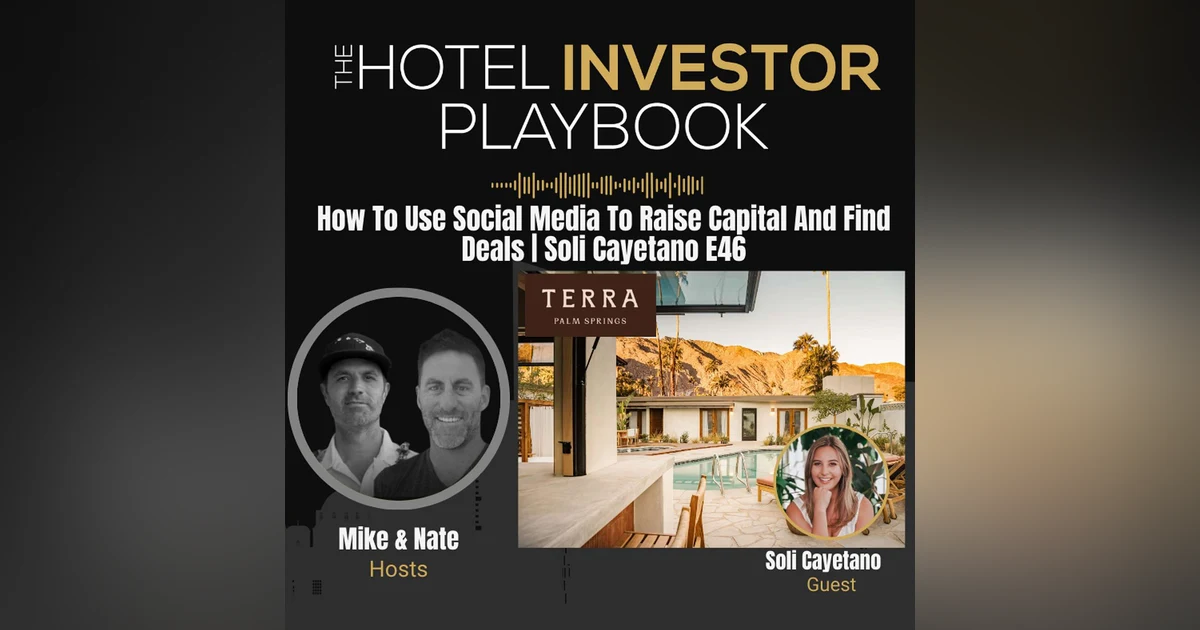
What if your first hotel deal could be funded almost entirely through Instagram? This week’s guest, Soli Cayetano AKA lattes.and.leases on Instagram, went from barista to building a $13M real estate portfolio in just four years. After exiting her residential investing business, she turned to hospitality and now co-owns a 13-key boutique wellness hotel in Palm Springs that’s already been featured in Forbes, Vogue, and Travel & Leisure. In this episode, you’ll learn: How Soli raised $2.5M i...


 RSS Feed
 What if your first hotel deal could be funded almost entirely through Instagram?
This week’s guest, Soli Cayetano AKA lattes.and.leases on Instagram, went from barista to building a $13M real estate portfolio in just four years. After exiting her residential investing business, she turned to hospitality and now co-owns a 13-key boutique wellness hotel in Palm Springs that’s already been featured in Forbes, Vogue, and Travel & Leisure.
In this episode, you’ll learn:
- How Soli raised $2.5M in 60 days through her Instagram audience
- Why documenting your journey builds trust with investors
- The key differences between residential and hospitality investing
- Why losing money can be the most valuable education
If you want proof that bold moves, social media, and persistence can change your life, this episode will give it to you.
Follow and share the Hotel Investor Playbook so more people can learn how to invest in hospitality assets the right way.
About Soli:
Soli Cayetano is a real estate investor, educator, and boutique hotel owner who has scaled from buying her first out-of-state rental at 23 to building a multimillion-dollar portfolio and co-owning Terra Palm Springs, a 13-room wellness boutique hotel featured in Travel + Leisure, Forbes, and Vogue. Through her platform Lattes & Leases, she empowers new and aspiring investors with the tools, courses, and community to confidently analyze deals, raise capital, and manage properties. Soli is passionate about creating design-forward, thoughtful hospitality brands while making real estate investing approachable, fun, and impactful.
Contact Soli:
Instagram: @lattes.and.leases & @terrapalmsprings
Website: https://www.terrapalmsprings.com/
LinkedIn: Soli Cayetano - Wellness Hotel Owner & Marketing Strategist
Connect with Mike and Nate:
Invest with Mike & Nate: malama-capital.com/invest
Submit a deal: https://www.malama-capital.com/deal-submission
Instagram: @the_hotel_investor_playbook
Contact Us: info@hotelinvestorplaybook.com
Welcome to the Hotel Investor Playbook, your guide to building wealth and freedom through boutique hotel ownership. Hosted by Mike and Nate. Get in the game. Welcome to the Hotel Investor Playbook, where Mike and Nate, founders of Maloma Capital, and your host. On this podcast, we talk story about everything you need to know to make money investing in hotels and hospitality assets. On today's show, we have Soli Cayetano. Soli, welcome to the Hotel Investor Playbook. Thanks for having me. So for our listeners, Soli, your story is incredible, right? You're you're you started out as a barista. You built this multi-million dollar real estate portfolio in just a few years at a very young age. And now you're the co-owner of a hotel on Palm Springs. It's called the Terra Palm, which it's a boutique wellness hotel. It looks absolutely gorgeous. It's been recognized by travel and leisure and Forbes and Vogue. It's killer. And you also are the founder of, well, you were, you are the founder, but you were running Lattes and Leases, which is a mastermind course that teaches people how to build wealth through real estate. So we're excited to have you here today.
Soli CayetanoThanks. Yeah, I'm excited. I started out actually in commercial real estate as a broker. And then I made my way into residential real estate. So actually, I feel like going, coming into hospitality is almost a return to commercial. And I'm excited to be here.
Michael RussellYeah. I should add to that real quick, though, that you you recently sold, successfully exited from your mastermind course. You you had someone said, Hey, this is so awesome. I want to purchase it from you. So congratulations on that.
Soli CayetanoThank you. Yeah, that one was called Hello Rentals. So I taught people in my five years of residential investing. I had a lot of people ask me how I scaled a portfolio so quickly. I grew as $13 million in four years and started from scratch with nothing but $50,000. So I taught people how to do the same in affordable markets. And as I pivoted into hospitality, I was ready to, I guess, close the chapter of residential investing and go all the way into boutique hotels. And so that's when I ended up actually selling that business a couple months ago. Okay, what was the name of that business? Hello Rentals.
Michael RussellOkay. And Lattes and Leases is my personal brand.
Nathan St CyrYeah, I'm gonna, I'm just gonna I'm gonna call the timeout right here because and the reason for it is because, well, first of all, some people know I'm a girl dad. It's like my greatest, greatest joy. And I did not have a social media platform until about nine months ago. And then as soon as I as soon as I I got, okay, I'm a 49-year-old man. It's it's time to go and grow. One of the first things, obviously, when social media started to recognize the types of things I like, I saw lattes and leases. It kept popping up. And as a girl dad, I'm like, dude, what what is what is this? What is she doing? This is awesome. And then I started, you kept coming up and I went and showed my daughters. I'm like, look at this lady kicking ass as an entrepreneur. So I just wanted to let you know that I'm pumped to have you on because early in my social media journey, you were there and you were kicking ass and you had a huge following, and you were, you were really, you were really showing people how to how to change the trajectory of their lives. And you've changed the trajectory of your life by going all in. So I just got to ask early on here. I'm curious as to in this, in this journey, in all of these different things that you've done, what do you feel like is your boldest move that impacted your trajectory?
Soli CayetanoOoh, I mean, I feel like everything comes down to buying my first rental property, but then also deciding to share that publicly online. And I think a lot of people are nervous to share it online because they feel like they may fail, they may fail publicly, they don't have anything to teach. And if they share publicly, then people are watching them and they may crash and burn, and that would be embarrassing. And so I went out on this mission. It was COVID 2020. I was a senior in college and I was quarantined in my house in the Bay Area and decided that I was going to buy a rental property as fast as possible, and I did in 12 weeks. But I started at Instagram before I ever even owned a rental property, and I had no clue what I was doing. I I guess I am Gen Z, so I'm predisposed to social media, but I failed. I had freak outs, I had mental breakdowns, I was dumb on social media. But I feel like that was the probably the most important step that I took that maybe I didn't even know how bold it was at the time, but it has been a trajectory for everything in the ability to grow my portfolio, raise capital, have people believe in my vision, have people believe in me. That was like such an important step in my journey.
Nathan St CyrWell, I'm gonna just say right now, from a personal note, thank you for just voicing that into the universe because I I just needed to hear that today. So, no, seriously, I mean put yourself out there.
Soli CayetanoI know.
Nathan St CyrWell, it it is. It's a it's a vulnerable place to be. And I think that's probably why I avoided it for so long. But and then just because we're you launch and we're on this journey doesn't mean that that necessarily makes things easy, especially when when you may have a struggling day. So anyway, just hearing you say that today is like, yeah, all right, baby, let's go, let's keep going.
Soli CayetanoYou never know. I I think it's interesting to know, like you never know who's watching you, which could sound creepy, but could also be amazing because you could have someone who wants to give you a million dollars to buy your next hotel. You could have someone who wants to partner with you who's bringing the next big thing that you can imagine. And the coolest things in life have all come from social media and some of the opportunities, like even selling my business with someone who I met on social media, finding my partners for the hotel on social media, being on Good Morning America social media. But it's crazy to think that like at any point someone could drop a DM that could change your life.
Michael RussellAll right, so Sully, take us back to your first deal. From what I understand, you bought it sight unseen, 2,500 miles away. You live in the Bay Area and you bought a property. Like I said, sight unseen. Walk us through that.
Soli CayetanoYeah, so I bought it in Cincinnati, basically off of Zillow. It was $97,000, and I flew out there and attempted to learn how to renovate it myself. So no experience, no family in real estate, no idea what I was doing, just me, a hammer, and maybe 500 Instagram followers who were really the people who taught me how to invest in real estate. So I did it. I like did everything wrong the first time. I filed fired everyone on my team after working with them on the first one. And it was like a master's degree in investing in real estate. I got hooked and then I was ready to scale. So I bought 25 units my first year.
Michael RussellOh my goodness. Wow. And were those all site unseen? Like you were just buying them off Zilla?
Soli CayetanoWell, most of them, yeah. So I was living in the Bay Area and buying in Cincinnati, Ohio, all of them. So a 10 unit, a triplex, five unit. I was just going crazy. In the first two, three years, I probably bought 40 or 50 deals. I started flipping houses, like spinning into Augusta, Georgia, where the Masters tournament is, the big golf tournament. And I really got a crash course on just like all things real estate investing. I like to say, like, I mean, a lot of people ask me, do I out of state or do I start with something like a boutique hotel? And I feel like at least starting from out of state real estate and cheaper real estate, like my average deal was maybe $100,000. I got a lot of reps in. So I was practicing finding, buying, financing, raising private money, renovating, picking finishes, finding tenants. And I did that about 50, 60, 70 times before I bought the rental property or sorry, the hotel.
Michael RussellYeah. So there's a lot there to unpack, right? So number one, you took action. You started with a project that, from a relative perspective, there was uh a nominal risk. Um, but that gave you the confidence to go and purchase more. And you're buying these not in your own backyard, because where you live in the Bay Area, costs can be prohibitive. So you're doing research. So you now you're learning the skills to go out and evaluate properties without being there in person and interpret the market data to determine whether or not that is a potentially good market to invest in. And I think that this is important because you've mentioned now, okay, I'm now at the position where I'm scaling into hospitality assets. But how does one go from wanting to invest in hotels to doing so? In your scenario, you learned, you said you got the reps. You learned the skill sets by buying residential units and you had a team, you manage people, you learn how to communicate, you learn in many cases, probably the hard way. You had to fire people because you what you learn is what you don't want. And I think that this is so applicable in a lot of areas. When you look at enough deals, one of the skill sets that you learn is identifying quickly what you don't want so that you can cut out the noise. And so, although our podcast focuses on investing in hotels, the skill sets that you gathered, the reps that you that you took in investing in residential properties now is helping you to progress in the hospitality world. So I just I wanted to take a minute to acknowledge that piece. And what I want to lead into now is understanding if you were having success continuing to grow a portfolio in the residential real estate field, why did you make the conscious choice to shift into hospitality?
Soli CayetanoWell, I had a really bad health scare. So I quit my nine to five job in 2023. I was 23 and in 2023. And then I went and traveled the world for six months. And while I was doing that, I got ridiculously sick and no one could figure out what was wrong with me. I was just basically like in bed for months. And it turns out that I had a parasite and I had two parasites and heavy metal poisoning and all sorts of other things that were wrong with me. And it took me like nine months while I was flipping houses and running my mastermind and doing all these other things to just detox it out of my system. And while I was like in that state, I realized that as successful as I was in buying residential real estate, it really was not tapping into any of my creative side. I was flipping tons of houses and picking the same beige paint and carpet and flooring. And like it wasn't bringing me any joy. And so, mixture of having that realization as well as having a really scary health crisis that eventually I had to go through functional medicine to heal myself. I wanted to kind of bring this well this experience and couple it with something that was more creative and meaningful to me, but still in the real estate space. So that's how I ended up in hospitality.
Nathan St CyrYeah. The the the passionate asset class, which I find, I find is is a very common theme. You said something that was very powerful. You went and made that first purchase, and you said that you you got your master's degree in basically got your master's degree in investing in real estate. Mike said, well, that was nominal risk. But as a 20-year-old, a hundred thousand dollar purchase is like in a different state. That's for I mean, risk is relative. And so, but I think that this is a really important thing. Hey, I did say relative, by the way. I did. Okay, okay, but throw me under the bus. Uh no, no worries. But here's my here's my point here. The other side of that risk is the master's degree. Right. And and Mike and I talk about this all the time. When we were starting in the commercial real estate journey, we framed this very, very consistently. We didn't know what we didn't know. And so as we would make decisions on the next property, as we were moving forward, we would say, okay, let's talk about the risk. And we would go through and we'd be like, all right, so what's the if we were to do this, it weren't to work out this way, what's our, what's the plan B? Okay, worst case scenario based on what it's currently worth. Worst case, we lose a couple hundred grand. Are we okay with that? And that was always our answer. Our answer was, yeah, but we might lose that much monetarily as a worst case. But in doing so, we're getting that doctorate, right? We're stepping up now from the master's to the doctorate. And would we pay $100,000 to have that doctorate? What's it going to do for us? And I just, I think wherever someone is in their journey, there is the financial risk, and you could lose money, but at the same time, what you're gaining from that is that next level of degree that allows you to catapult the next opportunity. So I just wanted to highlight because when you said that, when you said the master's degree piece, it really resonated with me and it resonated with our journey and how we've literally made decisions based on based on that concept of paying for the education, of going through it. And the only way to go through it is to literally go through it. So good on good on you for that. Freaking, that was an awesome point.
Soli CayetanoYeah, I've lost a lot of money along the way, but I think about it the same way. I really feel like in your successes, you don't really take time to think about what I could have done better? What went really well? How can I do more of that? But when you're losing hundreds of thousands of dollars, which I have done before on projects, you really take time and feel like really think about how could I have avoided this? I then hire mentors to help me learn the skill to avoid it later. And I'm glad that I'm taking these risks in my 20s because I have the next whatever, 40, 50, 60 years, hopefully, to actually implement all of these lessons.
Nathan St CyrYeah. I mean, this is Mike just wrote a LinkedIn article on that called Success is a Poor Teacher. We heard it on a podcast with the Bolts and it just resonated with us. Success is the poor teacher. The lessons, though, that's the teacher that that really is valuable.
Michael RussellYeah. So you're talking about how the artistic opportunity of investing in hospitality really resonated with you. But you know, a lot of people just they go and buy short-term rentals. Do you own any short-term rentals?
Soli CayetanoI used to. I own two short-term rentals in Cincinnati, which may not be the best place to own short-term rentals, but I didn't enjoy them. I feel like it was hard to create a really unique experience. What I wanted to do was to create something where I could put in basically create something that I wanted to go to and be able to build really unique amenities that something like an Airbnb oftentimes doesn't support. I came again from the commercial sphere. I was a commercial real estate broker, and I love the scale of commercial and I love the service and the hospitality. I the first time I stayed at a five-star thousand plus night hotel, like I fell in love with that level of service. And that's something that you often can't provide in just a single Airbnb, as well as all the regulation things that are happening.
Michael RussellYeah, definitely. So you chose to take your experience investing in residential. You kind of breezed over the short-term rental and took the leap into investing in a hotel. You mentioned that you found your partners on Instagram. I'm curious to know, had you made the decision to go and invest in a hotel first and then you found the partners? Or did you find the partners and then were like, oh, I want to do what they're doing and join them?
Soli CayetanoSo I had it in my mind that I wanted to buy a boutique hotel. I at the time was not partnered with these two people, but I saw that they were working on a hospitality project. So I went and said, hey, I'll raise your capital for you if you need additional capital raised, because that is where a lot of my strength is. And they said, great, let's do it. They needed to raise, I don't remember what it was, like three or four million dollars. That ended up falling out of contract. That was a property in Colorado. And then collectively, us as a group, there's four of us now, went out and went to go find another market to invest in. And that's how we landed in Palm Springs.
Michael RussellGotcha. Okay, so you knew that you had an interest in in doing so. And you're like, okay, what can I bring to the table? Well, I've got this network of people that know, like, and trust me. I can go raise money off of my followers on Instagram. Let's talk about that. How much money did you raise and how long did it take?
Soli CayetanoWe raised about $2.5 million in 60 days.
Michael RussellDang. And out of that proportion of two and a half million, how much did you raise personally? All of it. You raised all of it?
Soli CayetanoYeah. Totally. Maybe besides maybe like, I don't know, $300,000, but the majority of it.
Michael RussellAnd most of these people, I mean, walk us through the your investor base, right? You're on Instagram. Were most of these people strangers that you knew from Instagram or were these friends and family? Walk us through who invested with you.
Soli CayetanoSo about 30% of the people were people who had invested with us before. And by us, I mean me and the partner who we were flipping houses together. And so us collectively had created these relationships with people. We would do these debt 12-month loans and we would return their capital they'd reinvest with us. So we had developed relationships with these private lenders who are doing short-term flips. And then when we pitched them this hotel, they were like, Great, you keep giving my money back to me every six months. I'm happy to put it in something for five years. That makes a lot of sense. The other 70%, I think there was maybe one family member in there. The other 70% came from relationships from Instagram. And this is actually an interesting story because when I years ago, like maybe two, three years ago, I started this Google form of people who were potentially interested in partnering with me one day. And over the years, I would just post it occasionally and say, if you're ever interested, just fill this out. And if I have a project, I'll reach out to you. And so after two or three years, I had like over 2,000 people on that list. People who wanted to invest anywhere from 50,000 to a couple million dollars. And so when we went out, and I've never had to use this list before because when I had to raise debt deals, like we were using, I don't know, a handful, 30, 40 different lenders over and over again. And through that, I raised, I don't know, $10 million collectively for those flips. We were recycling that money. But for this, it's it's a different project. It's equity, it was a syndication, it was five to seven years, it's more risk, it's not a definite return. And so I went to that list, that 2,000-person list, and we emailed every single person on that list asking them if they were interested in this type of deal. And so that's exactly how we raised the money. I didn't think that I would use that list, but it became really handy. And now I tell all my friends to put that on their Instagram too, because you never know, again, who's sitting in your Instagram who might have money that they want to invest with you.
Michael RussellOkay, I want to double click on this because we're right now in the process of building out our own lead funnel. Like we're having daily conversations about this. Okay, how can we provide informational content that our listeners, our followers on social media will gain value from first? That's what we want to lead with is providing value first. But then As we build a relationship, of course, we want them into our orbit, we want them in our lead funnel, and then we will provide the opportunity for folks to invest. And I'm curious what like I want the details of this process step by step from the intention that you put into something ultimately leads to results. You're not just on social media because you enjoy showcasing yourself. I presume behind that there is also the expectation that, hey, if I go pay it forward, people will invest in me. And so I want to know like the details of what you're putting out there like content-wise, and then how do you provide like either lead magnets or what would ultimately lead someone to gain enough interest to want to put their name on that email list? Like you said, oh yeah, it's not that simple. Just like anyone goes out, starts an Instagram account, puts out a form that says, here's my Google Doc. If you fill it out, I'll send you an investment opportunity. No, like I want to know the process. Can you walk us through it?
Soli CayetanoSo I think uh when people do that, they're leading with wanting something from their followers first. And they're thinking that they could, that's how they start their Instagram, is they're not really providing any sort of value, but they're expecting that people want to invest with them. But really, it's it is years of nurturing. So I mean, I've had my Instagram for over five years now, and people have consistently seen me take action, fail, get up, make new goals, open hotels. They've followed the entire journey. They've seen me fly out to Cincinnati, they've seen me get sick, they've seen me recover, they've seen me get into functional medicine, they've seen why I'm passionate about wellness, like they've seen me go to Pulani's classes. Like they know so much about me. And it's not just like I'm posting just for the intention of making like getting people to invest in me. It's almost like a byproduct of them again, like knowing, liking, and trusting me. So in the beginning, I didn't even know that private lending or have finding investors was even a thing you could do on social media. And there's rules around it. We don't have to get into that. But I was just wanting to put my story out there and show one, it's a good accountability for you if you put it out there, then you got to follow through with it. I wanted to network with people and then just have it almost as like a diary for me. But in that process, that is where people build a real connection with you. So first and foremost, it's about building a genuine connection and showing that you're the type of person who does something. There's 98% of the people who I talk to don't do anything. They say they want to do it, they say they want to do it over and over and over again. But then when it comes to it, they don't actually execute on it and then they don't do it well. So my audience has seen me execute countless times on goals that I put out there publicly. And it's all of those micro moments that compound into trust where my conversations with investors are no longer can you pitch me on why you would be a good investment? Literally they'll say, take my money, where do I wire it? I don't have any questions. So it's a it's a different way. I think it's shocks people that that's the conversation, but they have seen me deliver for five years. And so it's they've watched me and now they're ready. It's a kind of a passive way of nurturing your investors.
Nathan St CyrHey guys, if you're excited about investing in hospitality but still have a few question marks in your mind, you're not alone. Maybe you understand the potential, but you're not quite ready to take down your own deal quite yet. Early in our journey, both Mike and I invested passively alongside seasoned operators. It gave us the behind-the-scenes view and showed us a playbook while our money worked for us. That's what we offer our capital partners: a chance to be a part of real deals, see how they come together, and start building the confidence to do in yourself without carrying all the risk on your first go. If you'd like to know what that might look like for you, just click on the link in the show notes. Now let's get back to it. First of all, I love it. Again, it goes back to when you tell that story, the difficult part, and I think it's the difficult part probably for a lot of people is going, gosh, but I'm not as interesting as Soli. You are no, I know, but I'm just saying, like, this is the I'm like, crap, like, dang, what are people gonna care about watching me do? You just went through all of this stuff, and no, I'm I'm serious. I'm like, this isn't the same way. I'm like This is what happened but this is what happens, and I'm saying this because look, I'm confronting it, going out there to execute just like you said, to show people, and it's great to have this conversation, but I also think that it's this is you say it just like effortlessly, and for me, that's terrifying.
Soli CayetanoSo I think that you kind of compare yourself to the people who've been doing it for again like five, 10, 15, 20 years. And so you're in the very beginning, which is very exciting. But the average person, think about like 98% of the US or the world, they're not doing much of anything. They're doing their nine to five, they're going home, most people aren't that happy, they're not traveling, they don't have their own businesses. And so even what you're doing is really inspiring to people. And you're also on your own journey of growing your own portfolio. I think that what is really important is the aspect of storytelling. And so you tell people what you want to accomplish, and then you take them on that journey every day. And so I would think about okay, if you're trying to go out and buy a hotel and you want to do that in the next 90 days, then tell that this is 90 days of going out to buy my next hotel. And then every day, what are you doing to accomplish that? By the end of 90 days, people are gonna be so hooked on that that they're gonna be like, I'm ready to give you my money. I've been following this for 90 days and you're finally under contract. I'm so free for you. And that's exactly what we did. I did this Instagram series where it was 60 days. I gave myself a challenge publicly, 60 days to go under contract. And I posted a video day one, day two, day three, day four, and in 14 days we were under contract and people were shocked. So I feel like if you can think about that, there's a lot of interesting things that you can do to really get people hooked on your story. And that's how you can think about storytelling, brand building, taking people along for the ride instead of trying to position yourself as like the expert.
Michael RussellNo, this is personally really helpful for me right now. I I don't honestly, I'm not a fan of Instagram. I like, I'm just not uh people love it, and that's great. And you should love what you love. But me, just speaking candidly, like I don't like to stare at a screen like Instagram and scroll. So it's hard for me to get super engaged, but I know that's where the eyeballs are. So it's like this tug of war internally of putting myself out there on a device or a mechanism that I personally am not like thrilled to be on. But that being said, you're like, hey, just go document what you're doing. We want to go buy a freaking deal right now. We've been going through this process now where we've had two of our acquisitions fall out for a variety of reasons. It just happens. You go through this, you take a swing, and then things happen. But we're now we're attacking this. And so I'm like envisioning myself with the little tripod.
Soli CayetanoYeah. I mean, what's what's a shame is that you didn't really document the failures because that's what people really want to see. You tell people tell me that all the time. I think my personal brand is built on me sharing the crappy things that happen to me, all of the transparency, the money loss, the this and that, the things that don't work out, because everyone feels like they're so alone in bad things happening to them. And so you falling out of contract, that's the perfect story to tell because it tells people that like things happen, things suck, but what do you do? You just keep going. So I think those are the things that makes people root for you.
Michael RussellCool. That's helpful. So we talk about this all the time. There's four pillars of real estate investing. And, you know, what you're describing, the capital raising. So the four pillars, right? Acquisitions, so to go for financing, whether that's capital raising or debt, there's operations and there's marketing. And you are describing that your zone of genius so far, what you've what you've done is you've done very well in the marketing aspect and very well in the capital raising. And those two kind of intertwine each other a little bit. Like you have a passion, you mentioned for the the design aspect of it, more of the artistic part of it and providing experiential lodging for people so that there's something fulfilling about curating experiences others are going to enjoy. That that just that that is personal joy that you are you are manifesting for others. So I get that. My zone of genius is, or at least the area where I would like to think I press into is acquisitions. I love it. I love deal hunting. I love talking with brokers. I love walking through a property and you know, figuring out the financial analysis so that the deal can work, structuring the deal, the negotiation, the art of it, everything. And so I want to press into that a little bit because you bought a it's a 12-unit hotel. Is that correct? In Palm Springs?
Soli CayetanoIt was 12 and we made it into 13.
Michael RussellOkay, awesome. Why Palm Springs?
Soli CayetanoSo after we filed a contract on that Colorado Hotel, I was at this master, it was I don't know, it was an event. Like it was seven people, 10 people there. And I happened to sit next to somebody and say, I really want to buy a boutique hotel. And this is also the power of just putting out your intentions out into the world because what did she say? I own a hotel and it's in Palm Springs. And I thought, wow, amazing. And so from that meeting, she introduced me to her broker, and I flew out. Actually, the whole team flew out like the next week, and we went under contract the next day. So it happened really fast. It really was because of that connection. Whenever I tell people how to like choose a market in an out-of-state area, like trying to pick an out-of-state market, it really has to do with like where is your competitive advantage? Where do you have a team? Where do you have a realtor? Where do you have a contractor? And she became my competitive advantage in Palm Springs. That, along with there were some really key things that we were looking for. We wanted to be within driving distance of some major metros. So it's two hours from LA, two hours from San Diego, and an hour from Joshua Tree National Park. And we also wanted to have the ability to see that there was luxury in the market. So the top end of Palm Springs, there's properties that are charging $2,000 plus. And so we knew what was possible. There's a lot of markets around the country where you're topping out at three to $400. And we didn't want to be limited into what we could put into our hotel and the rates that we could charge. So those were the kind of two things, I guess three things that we were looking for in a market.
Michael RussellOkay. So let's talk nuts and bolts a little bit. You've got a 13-key boutique hotel in Palm Springs. You want to appeal to the more upper scale, upper class avatar who's going to want more of a wellness style hotel. So that's how it's being marketed. It's boutique, it's designed forward. What makes your hotel different from the other options out there?
Soli CayetanoSo in Palm Springs, there are no wellness hotels. There are spas, there are hot springs in nearby areas, but not in Palm Springs. The average Palm Springs hotel is super colorful. It's kind of zebra print, it's disco balls and flamingos. And when we bought a hotel in Palm Springs, everyone's like, great, I love the Palm Springs aesthetic. But we're like, no, we're going in a completely different direction. Wellness is just booming. Like it is going to be a trillion dollar industry in LA. It is a major hub for wellness. But when you look at the demographic of Palm Springs, your biggest metro that you draw from is Los Angeles. And there's nothing wellness related for them to go to. So that's where we are like, there's a real niche. I'm very passionate about wellness personally from my own journey. And we think that we can do something special. It's the type of place that I would want to go to if I was going to a hotel.
Nathan St CyrAnd so what defines wellness? We have a concept. It's just obviously this hot marketing word, wellness, wellness, and trillion dollar, wellness, trillion dollar, wellness, trillion dollar. Hear it all the time. So this is where we're going. Wellness. And because hospitality is a passionate asset class, obviously, when you take health and you take activity and you combine them in a commercial real estate asset, it's like the holy grail. So, but what I know, like what actually defines what you said, there's no wellness there. What defines what wellness is?
Soli CayetanoThat's a great question. And no one has ever asked me this question. I think generally it is well-being front and center. And so that is everything from the amenities that we offer. So it's not just a pool. We have a sauna, a cold plunge, we designed a rain room that's like very meditative and it has thunderstorm noises in there. And even down to like the cocktails that we have that have marine collagen in them and spirulina, the bikes. We have partnerships with higher dose red light therapies. So it is putting like guest well-being, usually that's in a physical and mental capacity, front of mind. So that's the primary reason people come. We actually see a lot of people coming for a solo retreat or an escape from work. I think it's a different avatar than saying, come to our hotel and party. We've got a bar and a karaoke machine. It is come here to relax, rejuvenate, go to the spa, enjoy, take a bath, reconnect with nature. That is the front and front and center of our hotel.
Nathan St CyrSo when I think of that, when you describe that for me, what whatever is presented, then I also think, okay, well, what's the financial viability? And so when I hear a small room boutique hotel, and then I hear stacking bar drinks and then spa type things or like really serving the client, then I think and offering these amenities, I go, okay, well, what's the cost to operate that amenity? Let's just use the sauna. So I get a sauna in an SDR because at the end of the day it can be cleaned when the person is gone, right? Okay, this family unit uses it and then they're they're gone. But in a little boutique hotel, then I'm thinking, well, man, who just sweat their balls off in that thing? Like actually, you know, like I mean, but but that's what it but so I because I'm thinking like the financial part of it, like, well, yeah, what has to be done? What staff needs to run it? How does a person sign up for their time in there? Can they go anytime they want and then they leave? So I think through the operations, how do you execute that at a high level without breaking the bank, especially when you're running a small 13 rooms?
Soli CayetanoWhich is why you kind of have to go more mid-tier luxury. Palm Springs is a market where key less entry does not work that well. They expect staffing. They want you to hand them a drink and a towel. And if you don't have that, then you can't kind of command the rates and occupancy that that hotels do with staffing. Obviously, it's a cost, though. But we have all of those amenities open all day, no reservation. People can use them when they want to use them. And then we just, I mean, we have cleaners on site a lot, like a lot of the day because they're refreshing rooms. So they'll also just go and refresh and clean like the saunas and the common areas. It's not like one person goes and then everything gets cleaned. But when you think about a like a sauna in a hotel, a lot of hotels have saunas. It's not like they're going and cleaning it every 30 minutes. Does that make sense?
Michael RussellIt does. But you know what time it is? It's it's hot seat time. I'll I I'm kidding a little bit because I want to ask some tough questions. And I know, Sully, that in this partnership, operations is not your focus. I get that. But I'm asking for my own personal knowledge because sure, yeah, we'd love to have a killer hotel. What happens that I'm what I'm finding when I'm analyzing the smaller keys is that there's not quite the economy of scale to pay for the staff to be able to support the environment that I want the hotel to be able to have. For example, I'm imagining cool boutique, hotel wellness. I'm imagining like I hop into the sauna and I just throw my towel wherever, and then I go up to the bar and I order a drink, and a bartender's like shaking the cocktail right there and making the noise and pouring me a drink with an umbrella in it. And I'm like, yes. But in reality, what I know is, man, with 13 keys, there's just not enough revenue to support the staff to be able to provide that experience. So what ends up happening a lot of times is what I've done is I've stayed at these hotels and you're right, they have remote keyless entry. They don't have staff checking you in. So it's like, okay, the photos look incredible, but when the experience occurs, it is very similar to a short-term rental. It's designed forward, it's got the wellness amenities, but it doesn't have the personnel. And so now I'm just like sharing an Airbnb with strangers. And I'm feeling a little sense of hollowness. Like I hate to be harsh, but this is the dilemma that I balance when evaluating properties on what we can do to really progress this to make it valuable. And I'm wondering how do you guys balance the tension between cost control and guest experience?
Soli CayetanoIt's a great question. And I would agree that 13 rooms is basically the very minimum you can have to have the profitability with the staffing that we have. Because we have two general managers who alternate on schedules. We have two bartenders who alternate on schedule. We have three cleaners, we have three massage therapists all on staff. That's a lot of staff for 13 rooms. I would say that past this, this was really us trying to figure out, you know, this was our first foray into hospitality. So we didn't want to go out and buy 50 keys, but you know, for the next one, we definitely will, because there is that economies of scale that you need when you're providing a high level of service. So, you know, we have right now, like today, we have 88 Google reviews, five stars, all of them, and pretty much every single one of them that mentions our staff. They're saying by name, your bartender, your general manager absolutely made my day. And this was the best part of the experience. And so I definitely agree with you. You need that in order to provide the level of service that you want, especially in those like mid-scale, higher-level boutique hotels. And that's why you have to charge more luxury rates. So I think that that's kind of a non-answer in that this project is profitable. We're going to hit our metrics. We've outperformed our revenue by 25% on our pro forma. We are gonna achieve 17% IRR for our investors, our equity multiple is 2.63. So, like our investors will make money, but like knowing that, I think we will pursue larger hotels for exactly this reason. We love service. And to provide service, you need more keys to provide it.
Michael RussellYeah.
unknownYeah.
Michael RussellI mean, I don't know. Do you do you know offhand like what your operating expense ratio is to maintain that stuff?
Soli CayetanoI do not, and I can ask if you want to.
Michael RussellSo it's helpful. Like rule of thumb, I look at a lot of hotels and I go, all right, 60% occupancy expense ratio. That would that would be appropriate in many situations, depending on the level of luxury, then that expense ratio is going to go up significantly. If it's more economy mid-scale, you can hover around the mid 50% expense ratio and reasonably underwrite the deal to work. But I have no idea what it comes to when with these smaller ones. And man, you guys like you you could be knocking out of the park with charging the rates that overcome the limited amount of units. Because you have you have high rates. I I just don't know.
Soli CayetanoYeah. And and I feel like the main, the core staff is is the general managers and the cleaners. And that's kind of what like the bartenders, they pay for themselves. They're typically paid fairly low hourly and then they're paid tips. And so they sell a drink, it covers their payment for the entire hour. And so that staffing is pretty negligible. The massage therapist, we do a commission-based model only. So they take 40%, we take 60%. And our massages in six months have generated $45,000 and 150 square feet room. So I feel like that's actually a pretty compelling model. Like we will probably hit $90,000, $100,000 for just massages, but our expense ratio on that is pretty much 40%. 45%. So I think a lot of people think that Realmist is nice and a luxury, but it doesn't make money and that's kind of like a loss leader for the experience. But for our massage center, like it actually is a huge revenue generator, and our bar basically pays for itself.
Nathan St CyrThat's awesome. I've I would think that those amenities are yes, it can help drive ADR, but the amenities themselves don't create the vertical line of additional revenue. But to hear that you're creating that, that margin through the massage program, that's cool to hear.
Soli CayetanoYeah, we didn't expect it to go, but we've gotten granted, like we just opened in January and now we're in slow season, but we've had several months where we get $10,000 worth of massages. And for us, we're like, wow, that's amazing. And I think a lot of people think FB has been a challenge at a small hotel, but we don't have a commercial kitchen. So what we did is we formed a partnership with a local restaurant, and it's like a James Beard award-winning restaurant, and people can order directly from them and they deliver concierge to our doorstep, which is really awesome. It's beautifully plated. So we found ways to work around this because it is, it's true. Like you really have to watch every single expense when you run a small hotel. And in the beginning, we were wanting to create food and sell food, and we're like, I just don't feel like this is feasible. So we've had to get creative in in the areas that are traditionally not that profitable, like food, forming partnerships where we don't carry any inventory anymore. We just get a percentage of sales, and so we don't lose any money that way either.
Michael RussellYeah. No, I I get it. Sometimes I press in like this. The last episode we recorded with Brandon Gore, I was I was kind of digging into his financials a little bit and he pushed back. He's like, no, look, this is this is profitable because he had a, I don't know, was it like a 10 or a 12 unit hotel that he's building as well in Arkansas, Nathan? Is that right?
Nathan St CyrOr is it yeah?
Michael RussellAnd so similar in scale, but from a profit perspective, people are paying top dollar because he's not just building basic lodging, he's building upscale luxury lodging. And so in your model, you mentioned that there are units in Palm Springs that people will pay upwards of $2,000 a night for. You said that that's not quite you guys, but in high season, what kind of ADRs are you targeting?
Soli CayetanoOh, in high season, we have rooms that go up to $1,000 a night. Our ADR is lower though, because it's a pretty seasonal market. High season is January through May, and then summer is $110, $115. So June through about September is fairly low. Our ADRs will probably shake out to about 400s level, but during high season, like you're routinely getting at least weekends in the 800s, 850s, that type of range.
Michael RussellYeah. No, well, it makes sense. You've got people from LA that have money. So, like you said, your buy box is hey, two hours from a major metropolitan area, buy the buy box that palm springs fit the buy box for what you were looking for. I'd like to know moving forward if you can wave a magic wand right now and find the right deal in the right place. Like, what kind of markets are you looking at?
Soli CayetanoThat's such a good question. And we've been talking about that with the team. And for once in my life, like I have always been the person that just buys, buys, buys, scales, scales, scales, and we'll figure it out later. And for this property, I feel like I've matured where we opened it and we're really stabilizing it and trying to be intentional about what we want to do before we buy the next one. Where if I was younger, I would have bought a second hotel before we even opened. So that's like my speed of working. So, I mean, we've looked into a lot of different markets. Like my partners live in Seattle. So, like that type of market would be really interesting. We've looked at Santa Barbara area, Ohio area. We really like the West Coast. We're West Coast folks. And so staying in areas where there is some evidence of high ADRs, but there isn't just an overload of wellness in it yet. So that's kind of what we're looking for. We're still in like the early stages, though, of figuring out what we want to do next for a long time. We thought that our next hotel would be in Palm Springs for the economies of scale. But as they really started looking at the economies of scale, we didn't find actually as many as we were hoping to. Because the most expensive expense is your general managers. And if you're wanting to provide great service, it's not like your general managers can just drive over to the other hotel and drive back. And so, although like our back-end EA team could support that, I think it's been a little bit less compelling as we really looked into it because we want to create another wellness hotel and we would be directly competing with ourselves in that market without as much economies of scale that we expected.
Nathan St CyrYeah, no, that makes sense because your general manager is extremely involved in the guest experience. And so kind of like a general manager that's overseeing their involved. And so it doesn't, it doesn't have the same payoff as more of that oversight position.
Soli CayetanoYes, exactly. Do you guys have any good markets that you're looking at right now?
Michael RussellI'm looking at markets where people aren't looking, quite frankly. Like I'm I'm taking a contrarian view. Palm Springs is not on my radar. It's not. Urban areas are not on my radar. We're looking in places like Idaho, Montana. There are some places in the Pacific Northwest, but I don't like anywhere near places where it rains all the time. I'm not fond of the Pacific Northwest for that. I like places where there is a major attraction that's at least two hours from a major hub, so that there's like an airport people can go to or there's a major city, but I want it to be far enough away from the city to where they can't drive there in a day and come back. So, for example, Big Bear has a lake and it has a mountain. So it has those attractions. People go there for a purpose. If you're not familiar with Big Bear, people listening to this, Big Bear, California is a mountain area that people ski at, and then in the summertime they they go on the lake and fish and do boating stuff. It's beautiful. There's a ton of hotels in Big Bear for sale right now that are all highly discounted. The challenge is people go for a Saturday, they come back Saturday night. Big Bear, when I was a kid, I grew up in San Diego. I I thought it was cool back then, but now as an investor, I see this is not a good thing. I thought it was cool that I could snowboard and surf in the same day. Right? Because I could drive up there, I'd get the mountain experience and come right back and stay in my own bed that night. That's the problem with markets that are too close. So it's gotta be just it's gotta be in the the gold, what is it, the the the Goldilocks zone or the sweet spot is what is it, Nathan?
Nathan St CyrThe golden zone.
Michael RussellThe golden zone? Yeah, it's gotta be far enough away from a metropolitan hub that the people will be like, ah, it's too inconvenient for me to drive back on the same day. But it's gotta have a lake, a river, mountain, it's gotta have some golfing, it's gotta be near a uh a major national park. That's kind of our buy box criteria. It's gotta be at least 20 feet.
Soli CayetanoSomeone just reached out about a big bear property, two big bear properties. And so I was just looking there and I was like, wow, there are a lot of places for sale in Big Bear right now, which was a little concerning.
Michael RussellYeah, they're they're getting a little desperate. So, you know, that hey, look, everyone's got their their perspective, and that's just that's mine. I don't get as attached to the pride of ownership per se. And I'm not saying that's a bad thing. Like when we've had Seth and Tori Bolt on our show, they just they just bled passion. I mean, you're talking about experiential lodging, like they live, breathe, like everything is just about hospitality. And I love that for them. For for me, the way I look at things, as I love building wealth for the security of my family. And for me, when I go on vacation, I'll go enjoy that experience, like without thinking about business. But for business, whatever is going to provide the safest and most secure and an investment and the most upside, that's what I'm attracted to. So I don't care if it's a roadside motel or if it's a luxury wellness spa, how does it perform financially? And that's just kind of my lens on investing.
Soli CayetanoYeah, I would say I'm probably in between the two of you guys. I do care about the return, but I really do think that the creating an experience is really fun. And I did a lot of not fun real estate investing for the last five years. And so I feel like it's my time to to have a little bit more fun with investing. And I I do feel like that with my background in marketing and building my brand and social media, it's been very, very helpful as well. And the skills have transferred very well into creating more of that Instagrammable experience for people that gets booked more, has higher ADRs, and has better occupancy.
Michael RussellYeah. And absolutely, don't get me wrong. Like I want to commend that because that is valuable. To have pride in ownership is I am not by any means saying, hey, it's all about just the financial aspect. It's not. It's absolutely fulfilling to purchase something that is worthwhile curating.
Nathan St CyrI also think, though, that there's there's a space, like if we look at our own, we are the opposite avatar of our award-winning hospitality assets. We have the number one small hostel in North America, and we are the opposite avatar. And the entire community of our hospitality asset, it's all about experience. Everything we built was about experience. So I do believe that regardless of if that's our primary focus, because I can be more excited about a super eight than providing that hostile experience. Either one, though, from the financial viability standpoint, is important. And then with it, there is this, okay, well, what service is it that we are providing? And let's go do it and execute it at the absolute highest of our ability. So whether that's like your outcome is the creativity and passionate side, you can passionately develop an experience, even if that isn't your primary driver. And we've we've proven that model out.
Michael RussellYeah, when you said that you are running, I I forget the exact score with your reviews, but it triggered me because those guest reviews, I know what it's like to read those and have an emotional reaction when people are pouring into the review that the experience that you built that they're taking away with them when they go back home, that they're gonna treasure that vacation, those moments, those shared experiences with the people that they they spent it with. So I know exactly how awesome it is to feel like, wow, I had a role in impacting someone's life by providing them this awesome vacation experience. And that goes beyond just the financial metrics. That that's that's something that you earn that has value in a different way.
Nathan St CyrYeah. And Sully, I want to I want to ask you this as somebody that's been so successful with your capital raises and had had partnerships through all those flips. Cause because I wonder this hospitality has does have, I call it the passionate asset class, right? There is this passion of experience that comes with it. But knowing the capital raising side and the investment side of people that are contributing, partnering with you from a passive stamp, they know you, they like you, they trust you. And you've got two opportunities. One of them has a 17% return, and one of them has a 23% targeted return. One of them has a great passionate story behind it, and one of them has more of a commodity experience to it. They trust you, and you're gonna deliver either one. Which one do you think that they're gonna choose? Or do you think it depends on the person?
Soli CayetanoI think it absolutely depends on the person. And we talked to a lot of people who were pitching to invest in Terra, and I would say like half of them just said, I kind of want more cut and dry asset class, like multifamily, I like self-storage, and I just don't really care about hospitality. It seems like it's pretty variable, it's kind of based off of business. Like, I don't know, it's just not really my thing. The other half of the people who chose to invest with us were uber passionate about the idea. So they fell in love with the vision. They fell in love with the concept, they fell in love with the story. And it was like a hell yeah, I want to be involved in this thing, and I wish I could invest more money in it. And so I feel like there are investor types, there's so much money in the world. And I feel like that's what I've learned from raising a lot of capital is the amount of money is just infinite. The real hard part is like having a really good deal and then building a relationship where then you could then convey that opportunity. But there are investors for every single type of opportunity that you might bring to them. And it depends on their risk tolerance, it could depend on where they are in life. Or are they a passionate person? Or do they just like financials? So I think that I would prefer to work on the one that has a better story and maybe a little bit less of a return because it brings me more joy in life, and that's kind of what I'm after. But there are definitely avatars for each of those projects.
Michael RussellCool. No, I appreciate your opinion. Yep. Well, you've got a bright future ahead of you. You've done some amazing and some inspirational things. The hotel does look killer. I'm looking at the website right now, and if you've played a part in that design, I could see why it's it's gonna be a hit and it is doing well now. But I'm excited to see what projects follow up on this. So I'm definitely gonna be following your journey. I'm gonna reluctantly go on Instagram.
Soli CayetanoGive me a follow. I'm trying to post on LinkedIn more, so maybe you can inspire me to post on LinkedIn. It's uh it's an interesting place. Honestly, I find that there are like more, a higher quantity of quality conversations that happen on and from LinkedIn. I just feel like it's probably harder to build a raving fan base on LinkedIn. But like I've had people bring me hotel opportunities. I've had people reach out with really interesting partnerships. And I'm like, I'm shocked that that came off of three LinkedIn posts. I think that it's a pretty underutilized platform. And if you prefer posting on that, like why not go all in on LinkedIn?
Michael RussellYeah, absolutely. So if our listeners want to follow your journey and stay in touch with you and possibly invest with you, where would you recommend then? Should they follow you on? Is it lattes and Lisa's? I don't want to mess it up. Where do they get a hold of you on Instagram?
Soli CayetanoIt's yeah, Lattes and Lisa's, or you can just search my name, Sully Cayetano, and it'll pop up.
Michael RussellOkay, of course. We'll put that in the show notes. We'll put your LinkedIn profile in the show notes. So this has been great. Thank you, Sully. Thanks so much for being on the show.
Soli CayetanoYeah, thanks for having me.
Michael RussellThis is another episode of the Hotel Investor Playbook. We are Mike and Nate. She is Sully Cayetano, and we're signing off. We'll catch you again next week. Aloha.

